Becoming a Christian in Communist Russia
One of the treasures I brought back with me from Germany is a little book entitled Talking about God is Dangerous: My Experiences in the East and in the West My version is in German from 1984.Unfortunately, the book hasn’t been reprinted, so you can get a used paperback version for a mere $NZ256.
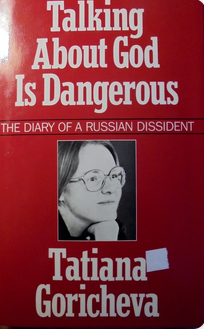 Tatiana Goricheva’s path to Christianity was nothing like yours and mine and also nothing like that of evangelical and charismatic Christians. A large part of the attraction that this book has for me is the fact that the author became a Christian in a radically different way.
 Tatiana (1947‑2025) was born in a land from which the traditional values of culture, religion and morality had been deliberately and successfully eradicated. Although she was baptized as an infant, her parents, as conforming citizens of Communist Russia, had nothing to do with the church.
Her first step as an intellectual with a great future, was an enthusiasm for the philosophy of Heidegger. The next step was an engagement with Yoga. Goricheva tried to exercise yoga with enthusiasm in Eastern philosophies in order to free herself from her reality. She wrote that yogic practice helped her to be more focused toward herself and allowed her to escape from a dreary conformity to the reality of a Communist state.
In a little handbook of yoga exercises was a suggestion, as an exercise in meditation, to recite the Lord’s prayer. This she did and somehow it became a transforming experience, leading her to make contact with the Orthodox church, about which she knew practically nothing.
The book opens with a scene in which she is being questioned by the KGB. From previous encounters she was suspicious of their attempts to get her to talk about her life; the result was likely to be getting her to unintentionally reveal something. So she refused to answer any questions at all, to the total bewilderment and distress of her parents. As a result, she lost her post as a lecturer in Philosophy after only two months. The only employment left to her was as a lift attendant, the lowliest job of all. The communist regime was brutal towards anyone who did not conform to their system.
She writes,
” I was on a journey from nowhere to nowhere: I had no roots and would go into an empty, meaningless future.
During my childhood I had a friend who committed suicide at the age of fifteen because she could no longer bear everything around her. She died and left a note, ‘I am a very bad person’ — and yet she was someone with an unusually pure heart, who could not bear other people telling lies and could not tell lies herself. This girl committed suicide because she felt that she was not living as she should and that at some point one had to pierce through the surrounding emptiness and find light. But she could not find the way. My girl friend was too profound, and an extraordinarily conscientious person for her age; she understood that she too had a share of responsibility.”
She was converted in 1972. About this, she writes that her sudden conversion changed her total viewpoint as well as her whole life. As was mentioned earlier, she suffered from a lack of love toward others, harbored immense bitterness, and led a nihilistic way of life in order to somehow resist the governmental ideology and understanding of life. She also says that her education instilled in her a sense of being in competition with others and needing to excel. She writes:
“And school only encouraged our external ‘competitive’ qualities. Praise at school is for those who can work better and higher, who ‘distinguish’ themselves in some way. That served further to consolidate my pride and bring it to full bloom. My aim was to be cleverer, more capable, and stronger than the others. But no one had told me that the supreme thing in life is not to overtake and to get the better of others, but to love.”
Shortly thereafter, she was influential in setting up a feminist women’s group, the Maria Club as well as a seminar that would deal with religious and philosophical themes. What concerned the other leader of the seminar (Sergei Stratonovskii), was a cultural problem. He could not understand how religion had always been the beginning of European culture and its breeding ground, so that the word ‘culture’ is itself derived from the word ‘cult.’ Sergei proposed that the seminar study the church fathers and contemporary theologians, even though he himself was not a Christian.
One of her first tasks was to go to confession. A friend of hers tells how she went to confession with an old priest. “Have you been involved with sorcery?” “Yes” she says, as she had taken part in seances. “Have you stolen?” “Yes” she says, as she once, as a child, stole a jar of jam. Have you murdered.” “Yes” she says, as she had had an abortion. Now the pious old women, waiting in the queue for confession, shake their heads and murmur disapprovingly. The priest can’t believe what he is hearing; he has no idea that he is dealing with a recent convert. She writes,
“The high level of demands in Orthodox faith is connected with its extraordinary flexibility and its gentleness towards human beings. How can this contradiction be resolved? Only through love. This specific, wise love in our pastor, who is endowed with grace to give us freedom.”
There weren’t enough priests to go around, but Father Leonid suggested that he could become their pastor. During the Khruschev era, in which many priests were brutally persecuted, the KGB asked him to give up the priesthood. “Only a few old women come to church nowadays and in a few years they will have died out.”
10 years later, young people were joining the church again; intellectuals, artists, writers, scientists and philosophers.
Tatiana was also deeply impressed by the Orthodox liturgy.
“I was utterly overcome by the Liturgy, by the beauty of the Orthodox celebration. The more I discovered Liturgy, the less I wanted to leave church after the service had ended; it seemed to me that I that I was leaving Paradise to rejoin Hell. I was caught up by all this, not because of the aesthetic beauty, but because it penetrated deeply into me — to the level of my very being, so to speak, and not to some superficial level.”
The result of her conversion and experiences of confession and liturgy was as follows:
“Finally my heart was also open. I began to love people. I could understand their suffering and also their lofty destiny. That they are in the image of God. Immediately after my conversion everyone simply seemed to me to be a miraculous inhabitant of heaven, and I could not wait to do good and to serve human beings and God.”
Exasperated by her refusal to conform to the Soviet system, the authorities gave her the alternative of imprisonment or exile. Encouraged by Father Leonid, she chose exile in the West. When she heard her first religious programme, she concluded that it’s not only in Marxist countries that it is dangerous to speak of God; the speaker nowhere referred to God for fear of putting people off. Talk of God is also dangerous in the West and leads people to talk superficially and externally of the divine.
The book dates from the very beginning of her time in the West. After then, she graduated from the St George Catholic Institute in Frankfurt and then from the St Sergius Orthodox Institute in Paris.
You would think that going to the West would be simply wonderful. In Russia, she lived with the continual threats of being bundled into a car and taken goodness knows where, being locked up in prison, or being confined to a mental hospital.
And indeed, when she gave talks in the West, it was to a large, appreciative audience. But she found the much-vaunted freedom of the West comes with its own spiritual vacuity. She characterized it as ‘post-nihilistic’ in its deep, conventional indifference to religion and the sacred. The capitalistic west has replaced spiritual reality with ‘hyperrealities’ like banks and stock exchanges and a superficial new ‘liturgy’ where supermarkets and daily consumer rituals become the new, empty sacred spaces. Her perspective as an ‘outsider’ can help us to see ourselves with new eyes.
See also:
Why did Tatiana Goricheva Return to and Believe in God. https://share.google/lwIuoan45b3G3AbPQ
-- Laurie Chisholm