Colin McCahon (1919 –1987): Prophet in the Wilderness - Part 2
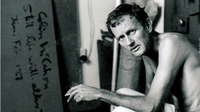
Lloyd Geering first delivered this address to the Christchurch Art Gallery on April 12 2008. Here is part 2. We have added links after the discussion of most artworks that you can follow to see them.
To realise that the world we live in is partly of our own creation makes us realise that what we often take to be as objective as a rock is partly subjective. Our world changes as we change and grow. And our world comes to an end when we come to an end. We have to come to terms with our mortality. During the 20th century it was becoming more common for people to accept their mortality as the old Christian certainties about immortality began to lose their power. That is why death in one form or another surfaced regularly throughout McCahon's painting career. To accept our human mortality, we have to see death in a more positive light. Death is actually just as important a part of our world as life. This McCahon expressed in Sacred to the Memory of Death (1955). The words come from a Turner drawing in the Auckland City Art Gallery and suggest a positive attitude to human mortality, such as that found in the hymn of St. Francis, who spoke of ‘kind and gentle death’.
Faith and doubt – 1958 and 1959
This led McCahon back to pondering the significance of the death of Christ, and a whole series of Elias Paintings. No more do we have scenes of the crucifixion. He now resorts to words and abstract symbolism. His Elias Triptych (1959) would make a genuine altarpiece. For the left-hand panel McCahon selected these words from Matthew's Gospel, spoken by the chief priests:
Sir, we remember that the deceiver said while he was yet alive, ‘After 3 days I will rise again.’
He shortened Pilate's reply to Seal the stone and set watch, and enclosed it in the stone which sealed the tomb. The right-hand panel draws from Luke's story of the two who encountered the risen Jesus on the road to Emmaus. Then he opened their understanding.
The centre panel is a fiery burst of activity; it symbolizes at one and the same time the death of Jesus and the resurrection of Jesus. Yet it is strangely like the mushroom cloud of a nuclear explosion. We know that the threat of nuclear war greatly exercised the mind of McCahon at that time. In 1961 he joined the NZ Campaign for Nuclear Disarmament. He later confessed that one of his paintings was like an exploding nuclear bomb - both beautiful and deadly - perhaps this was it.
Now come several paintings that deal with issues of faith and doubt, by taking up of the words of the bystanders at the crucifixion scene - He calls for Elias (1959) He calls for Elias. Let us see whether Elias will come to save him. There is no need to paint the figure of Christ; the cross is sufficient, since this is now so clearly symbolic. McCahon could well be asking, through the words of the bystanders, whether the world will be saved from a nuclear holocaust – notice the colour he uses. Or it may be – Can Christianity save itself in this period of its twilight? - in which case it becomes the colour of the sunset.
Then it becomes a question - Elias, will he save him? The cross is becoming less distinct, almost fading into the background as the question becomes more urgent. Doubt now becomes dominant and even more pronounced in Will he save him? (1959) Notice the oscillation between ever and never.
Finally, in Elias cannot save him (1959) McCahon delivers his own verdict, interspersing the statement with the taunting words that reflect those of the chief priests and scribes found in Mark, ‘He saved others; he cannot save himself’.
One of the reasons why McCahon was attracted to religion was the way it understood the important role of symbols in communicating visually what could not be adequately put into words, or what we call ‘the ineffable’. Even when McCahon used words, it was their symbolic power he was drawing attention to. In the sixties he painted two very important symbolic paintings.
Symbolism: XP and One
XP (1965) is an ancient Christian symbol that uses the first two letters of the Greek word for Christ. The first Greek consonant is one we do not have in the Roman alphabet. It is transliterated as ‘ch’, being like the ‘ch’ in Scottish word ‘loch’. It fascinated the early Christians because it was written like a St. Andrew’s cross. Superimposed upon it is the Greek letter for ‘r’, as the Greeks write it, though to us it looks like a ‘p’. The whole became a symbol for Christ and even for the Christian tradition itself.
In One (1965) McCahon focused first on one of the basic biblical terms for God. ‘The Lord our God is One’. This is a quote from the passage in Deuteronomy that the Jews call the Shema and serves as a kind of Jewish creed. But into it McCahon inserts the Roman numeral ‘I’, that is also the capital ‘I’. This is all of apiece with the great ‘I AM’s. Carl Jung’s depth psychology would lead us to see here at work the archetypes of McCahon’s unconscious. Jung believed we all share the same archetype in the structure of our psyche. It was because of a particular archetype that monotheism – the belief that the divine is one – triumphed over polytheism, the belief in many gods. But it is this same archetype that enables us in our internal experience to reach a mature sense of self-identity, or what Jung called the process of individuation. In the life of each of us, out of a plurality of early conflicting experiences we hopefully achieve, by mid-life onwards, a strong sense of self-identity. All this and more can be taken out of this richly symbolic painting.
See https://share.google/Co4fZlXAFxImBJphP
A question of faith – 1966 to 1980
During 1966-68 New Zealand was caught up in a widespread and very public theological controversy in which all sorts of people were airing their views on God, miracles, the resurrection of Jesus and life after death. In the aftermath, it is hardly surprising that in 1969 McCahon announced a new series that we may call ‘Shall we gather at the river’. Three of them are in the Australian collection. The one on the left simply says:
Let us then stop discussing the
rudiments of Christianity-
We ought not to be laying over again
the foundations of faith in God
and of repentance from the deadness
of our former ways,
by instruction about cleansing rites
and the laying-on-of-hands,
about the resurrection of the dead
and eternal judgment.
Instead let us advance towards maturity;
and so we shall if God permits.
These words come from the New English Bible, Hebrews chapter 6. Colin's wife Anne had just given him a copy and he spent much time pondering it. He used it in a whole series of paintings, some of them extremely large. We may group them under the title of A Question of Faith, a title he once used himself.
McCahon became fascinated by the Lazarus tradition, which he spoke of as ‘one of the most beautiful and puzzling stories in the New Testament’. McCahon realized this story cannot be taken literally without undermining the story of the resurrection of Jesus, for Jesus’ resurrection was acclaimed as the first. The resurrection of Lazarus is a symbolic story and is now widely recognized as such in New Testament scholarship.
The story of Lazarus is told in A Question of Faith (1970). The words I am and I am life are central in this painting. We now see that I AM, the symbol both for God and for self-identity, keeps returning. But seeing this is all symbolic, what does Lazarus symbolize for McCahon and/or for us? Is Lazarus the symbol of Christianity, now ebbing away? Is Lazarus a symbol of church, once full of faith but now losing its faith and its life? Something like this is confirmed by what came next.
See https://www.mccahon.co.nz/cm000015
In Practical Religion: the resurrection of Lazarus showing Mount Martha (1969 - 1970) McCahon continues with the texts of the New English Bible. What chiefly grasped McCahon is to be discovered in the words he highlights. ‘Let us go back to Judea’. ‘Lazarus is dead’. ‘Even now I know that whatever you ask of God, God will grant you’. And then even more important than ‘I am the resurrection’ is simply ‘I am’ and ‘I am life’. McCahon's paintings have become his own form of meditation in which he looks for answers to his doubts - he looks for meaning where there is chaos – for hope where there is despair. But he is also reflecting what was going on more widely in New Zealand, particularly in the light of the widespread public discussion and debate during 1966-70.
See https://www.mccahon.co.nz/cm001019
I AM becomes the focal point of Gate III (1970-71), once held by Victoria University. This is a gathering of all the major concerns McCahon had during the 1960s. Black clouds over a sombre landscape. Let us read from left to right. ‘In this dark night of civilization’ we read. Here we find words of doom from the prophet Isaiah - THE FLAME OF A DEVOURING FIRE - The earth staggers like a drunken man - Then the moon shall be confounded and the sun ashamed. ‘Teach us to order our days rightly, that we may enter the gate of wisdom’.Then the prayer:
God be gracious to us and bless us,
God make his face shine upon us
that his ways may be known on earth
and his saving power among all nations.
Compare this with Victory over Death (1970). This was the controversial painting that the NZ Government presented to Australia as a gift. So-called because it celebrates the victory of Christ over death. It records words that St. John’s Gospel puts into the mouth of the victorious Christ going to his death:
Now my soul is in turmoil and what have I to say?
Father save me from this hour.
No, it was for this that I came to this hour.
Then come the confident words,
I have glorified it and will glorify it again.
See https://www.mccahon.co.nz/cm000661
If this is also self-affirmation on the part of McCahon, it does not last. In the closing years of McCahon, as if assailed again by doubt, he focused on life and death. The predicament of human mortality and the uncertain future of the world itself allow no room for easy optimism.
In 1980 McCahon painted Storm Warning (1980). McCahon assumed the role of an apocalyptic prophet. Like a Hyde Park Preacher declaring ‘the End is nigh’, McCahon reflects here his strong premonition of the uncertain future facing humankind on this planet. If he had lived to witness the frightening destruction of the Twin Towers and the recent invasions of Afghanistan and Iraq by the Western countries he might have felt his fears being confirmed. He chose the words from 2 Timothy 3:1-2 in the New English Bible:
YOU MUST FACE THE FACT. (becoming his very dominant heading), followed by
the final age of this world
is to be a time of troubles.
Men will love nothing but
money and self; they will be
arrogant, boastful and abusive;
with no respect for parents,
no gratitude, no piety, no natural affection;
they will be implacable in their hatreds.
Paul to Timothy
See https://www.mccahon.co.nz/cm001187
Ending with Ecclesiastes
But McCahon was also facing the end of his own world. This had become all the more imminent because of the alcoholism to which he had become addicted. So near the end of his career McCahon turned to the book of Ecclesiastes, the most neglected book in the Bible. Ecclesiastes’ expressions of disillusionment with life fitted McCahon’s own mood at the time, downcast as he was because of so much hostility to his work and because he was already suffering the mental condition which brought his painting career to an end.
There is no book of the Bible which so pertinently fits our time as does the book of Ecclesiastes. These words could be McCahon’s final reflection, not only on his own life but also on the fate of Christian culture and even on the fate of humankind. Over 1980-82 he painted several paintings with texts from this book.
In I applied my mind ( 1980 - 1982) we read such words as:
I applied my mind to all this and I understood that the righteous
and the wise and all their doings are under God's control;
but is it love or hatred? No man knows.
Everything that confronts him, everything is empty,
since one and the same fate befalls everyone,
just and unjust alike, good and bad, clean and unclean.
In my empty existence I have seen it all,
from a righteous man perishing in his righteousness
to a wicked man growing old in his wickedness.
Why make yourself a laughing-stock?
Why should you die before your time ?
This is what is wrong in all is done here under the sun;
that one and the same fate befalls every man.
True, the living know that they will die;
but the dead know nothing.
There are no more rewards for them;
they are utterly forgotten.
Never again will they have any part
in what is done here under the sun.
See https://www.mccahon.co.nz/cm001660
Some may dismiss these last paintings of McCahon as the ramblings of an ill man facing death, disappointed that work for which he had given his whole life had not received better recognition. But there is more to it than that.
Ecclesiastes is the Greek translation of the Hebrew word Qoheleth, which means ‘the one who calls or summons’. Qoheleth was a Jewish thinker who lived, about 300 BCE, in a rapidly changing world where his own Jewish traditions seemed to be dissolving into unreality. He summoned his readers to face reality, to accept that nothing lasts forever, and to learn how to make the most of life while it lasts. Yet Qoheleth has been largely neglected by Jews and Christians until now. Its very frank expression of humanism now fits the current mood in western culture, as it did McCahon’s own personal state.
In moving through from 1947 to 1982 we have seen McCahon oscillating between confidence and doubt. We have seen him receding from the traditionally religious and moving further towards the very human. He expressed this in the way he moved from the colourful to the predominantly black and white. He began with the familiar biblical scenes, that still reflected the spiritual world of the ancients and he ended with the unfamiliar Ecclesiastes, that takes this all too human world as reality. As he did so he was also reflecting what has been taking place religiously in New Zealand culture. McCahon has been a modern Qoheleth, summoning us to have the faith to see the world as it really is, so that we too can get the best out of life. But it was only after his death that McCahon could be seen more widely as a prophet in the Wilderness.
Though he began with biblical scenes, at the last he was painting only words. If some object to his increasing use of words he could no doubt retort that he was only going back to the beginning of things, for do we not read that:
In the beginning of God’s creation of the heavens
and the earth God spoke the words,
‘Let there be light!’
Much later the Fourth Evangelist began his Gospel thus:
In the beginning was the Word
and the Word was with God and
the Word was God.
Bibliography
Apart from a multitude of smaller publications, many written for specific exhibitions, the two following comprehensive books are recommended. Both are generously illustrated, and should be readily available in New Zealand libraries:
Gordon H. Brown, Colin McCahon Artist, A.H. and A.W. Reed, 1984; revised edition (Auckland, Reed, 1993).
Marja Bloem and Martin Browne, Colin McCahon: A Question of Faith (Amsterdam, Stedilijk Museum and Nelson, Craig Potton Publishing, 2002.
Lloyd Geering