Colin McCahon (1919 –1987): Prophet in the Wilderness
Lloyd Geering delivered this address to the Christchurch Art Gallery on April 12 2008. Here is part 1.
Many people are not attracted to the work of Colin McCahon, even though he is now widely regarded as New Zealand’s greatest artist. I have no expertise to speak with authority on art. Rather reluctantly, some twenty years ago I was persuaded by Alexa Johnston, (author of the fine biography on Sir Ed Hillary) to speak about the religious aspect of McCahon’s work. He is the only well-known NZ artist who has devoted much of his work to religious topics. This presentation is a personal interpretation. I shall be speaking of him as a religious prophet.
I discovered I have a strong affinity with him. We were born only a year apart. The formative years of both of us were spent in Dunedin. We were at Otago Boys’ High school at the same time. Yet we never met personally. We had many friends in common, but we moved in different circles. About the very time he and his family were abandoning the Presbyterian church, I was joining it. Seventy years later, I see we were travelling in the same direction - he outside institutional religion and I within it. We were both involved in the same quest - the quest for authentic faith in a world where the traditional Christian dogmas were being questioned and some Christian symbols were dying and becoming obsolete.
Meeting Colin at Victoria University
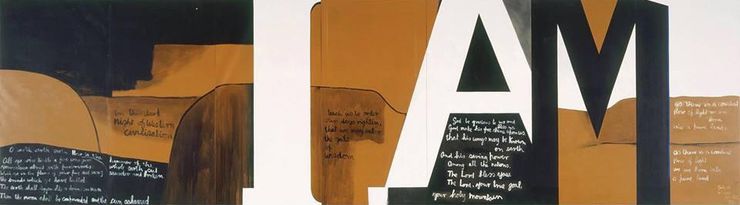
We first made contact of a kind about 37 years ago at Victoria University. I arrived to establish a department of Religious Studies. Colin was there to meet me - in the form of his enormous painting known as Gate III (1970-71). There was something oddly significant about this. Victoria University, because of its founding figures, such as Sir Robert Stout, had long had the reputation of being the most secular university in New Zealand. Yet it was the first to establish a Chair in Religious Studies. Moreover, it proudly displayed his Gate III in the foyer of its new lecture block with its dominating words – the great I AM. McCahon had got there before me and, like an early explorer, had planted his flag in the virtual heartland of what may be called New Zealand’s spiritual void. This void had been opening up between the religious institutions and the modern secular world as they increasingly rejected each other.
It was in the context of this void that McCahon increasingly assumed a prophetic role. A prophet does not so much foretell the future as interpret the present. He can be so far ahead of his time that it is only posthumously that his work will be widely appreciated. That is the case with Colin McCahon and I shall now try to show from his paintings why he has been called ‘a prophet in the wilderness’.
The 20th century was marked by the quite rapid decline of conventional Christianity. The truths, myths and symbols that had shaped Western culture for some fifteen hundred years were losing their force. They were now becoming tired, outmoded and irrelevant.
We are living in the twilight of the traditional form of Christianity, which once caused European culture to flower as Christendom. McCahon spelt it out in this painting Gate III of 1970. Of this painting Hamish Keith said, ‘Gate III is a stupendous work. It is at once a prophecy of doom in the best Old Testament manner, a prayer for help, an affirmation of individual faith and a revelation’. Note these words ‘In this dark night of Western civilisation’. The painting appears to be asking - Where does the decline of classical Christianity leave us spiritually? This is the question that is so powerfully reflected throughout McCahon's religious paintings.
Beginnings
Let us now go back to the beginning. McCahon’s life spanned the main part of the 20th century. McCahon said in 1972, ‘My painting is almost entirely autobiographical - it tells you where I am at any given time, where I am living and the direction I am pointing in.’ But his paintings not only tell us about his own religious experience; they also reflect the changing character of the Christian culture of the Western world.
So what was McCahon’s own religious background? He started as a Presbyterian. In his teens, he, and his family, left the Presbyterian Church and joined the Quakers (The Society of Friends). But when World War II broke out the Dunedin Quakers became caught up in a debate between the absolute pacifists, led by Archibald Baxter the father of James K Baxter and the moderate pacifists, led by the Brailsford family, who lived next door to the McCahons. The latter argued that the pacifism could not withstand the threat of fascism. From this time stems McCahon’s moral concern about war.
Then Colin married the daughter of an Anglican Archdeacon, who was herself a painter. (Anne stopped painting – ‘There is no room for two painters in the one family’). Years later, he even received Catholic instruction for a short time. But though he was attracted to Catholic symbolism he never became a Catholic, in the way his friend James K Baxter did. So in 1979 he declared, ‘I am nothing - I don't connect myself with any religious organization’. McCahon – which is just what so many New Zealanders were becoming during the 20th century. McCahon’s prophetic role was brilliantly demonstrated by the way his paintings asked questions about where our culture is going. He started off with a study of the European Masters and then painted a variety of biblical scenes with his own distinctive approach. They began in 1946. Biblical images and scenes – 1946 to 1950They begin with I Paul to you at Ngatimote (1946). Here began what was to be a common practice of his – putting, in juxtaposition, scenes from two different contexts – the Holy Land and New Zealand. In the foreground is Paul communicating (to the right) with Timothy in the first century. But in the background is twentieth century New Zealand, made clear by the aeroplane and the barbed wire fence. On the scroll we find the words, ‘I Paul to you at Ngatimote’ a Maori term meaning ‘Belonging to Timothy’. Paul is writing to Timothy (in the first century) but listening in (in the 20th century) is New Zealand, represented by no less a person than McCahon himself. By this juxtaposition, the artist is asking – Can Paul’s communication be effective over a time gulf of 19 centuries? To view this, click the following link: https://bit.ly/43zqmz8
To explore this McCahon turned to one of the earliest examples of the idea of resurrection in the Bible - the resurrection of the people of Israel, after their near spiritual death at the hands of the Babylonians. The Valley of Dry Bones (1947), of Ezekiel 37:9, is the only one of his early paintings drawn from the Old Testament. The prophet Ezekiel called to the Four Winds, namely the Holy Spirit of God, to breathe new life into the recently dead. But these are the hills of New Zealand. So the prophet McCahon could well be asking the question, ‘Can the dry bones of Christianity be raised to new life? Can the vitality of the Church be resurrected? And is this the Long White Cloud of Aotearoa?’ He even puts himself into the picture by means of an elaborate scroll for his signature, giving the exact date of November 1947. To view this, click: https://bit.ly/3QcBD5s
To resurrect Christianity in New Zealand we need to start where the Christ story began - The Angel of the Annunciation (1949). In the biblical story this was usually depicted indoors but McCahon chose the quiet of the NZ countryside. The angel arrives to a young woman on a farm, with the farmhouse in the background and typical hills behind. To view this, click: https://bit.ly/4vBjzku
McCahon then turned his attention to what had always been central to Christianity, the death of Jesus on the cross. That was the foundation stone of Christianity.
In Crucifixion after St. Mark, (1947), McCahon followed the Gospel of Mark very closely, though not exactly. The woman in the left foreground is surely Mary the mother of Jesus, who cannot bear to see her son suffering like this. Yet she does not appear in Mark; only John's Gospel makes reference to her. All the rest are as Mark describes the picture, including even the words quoted - the bystander who offered Jesus vinegar to drink, the one who mocked him, the Roman centurion who ‘stood facing him’ and said, ‘Truly this man was the Son of God’, and the three women at the far right, ‘looking on from afar’, identified as Mary Magdalene, Mary mother of James and Salome. To view this, click: https://bit.ly/4avyMeH
We now notice the scene has been lifted out of the holy city of Jerusalem and dropped down here among the hills behind Palmerston in Otago. The superscription over the cross has been shifted to the countryside of New Zealand, as if to say, ‘What has Jesus the King of the Jews to do with us?’ At the far right is a typical colonial church building in rural New Zealand. This is a New Zealand counterpart of the ancient Jerusalem temple – whose curtain was torn in two, from top to bottom. But here the tearing apart of the temple veil gives the impression of the church about to go up in flames. And who is this on the right? This is Colin McCahon himself, joining us as we view the scene.
The Aramaic words of dereliction spoken from the cross mean ‘My God, my God why have you forsaken me?’ But these words take on new import within the New Zealand context. They ask whether God has forsaken the church which, as the ‘body of Christ’, brought the Gospel to New Zealand. The bystander cautions, ‘Wait! Let us see whether Elijah will return once more’. I suggest that the reason why McCahon puts in the Gospel words is to challenge us to ponder the questions they raise in our time and in our place.
This painting is one of McCahon’s most effective ones. Yet it so offended viewers that Christchurch Art Gallery even refused to hang it. McCahon not only shocked the religious community, but even many in art circles were highly critical. Some critics insisted that his work be removed from galleries. (This painting now hangs in Christchurch Art Gallery, having been gifted to it some twenty years later by McCahon himself).
Naturally McCahon was very disappointed with the negative reaction, coming from many viewers. In 1948 Rex Fairburn wrote in the journal Landfall ‘Mr McCahon, a man of talent, is trying to get away from the dullness I have been complaining about, but these are completely lacking in every attribute of good painting. They might pass as graffiti on the walls of some celestial lavatory but that is about all. Pretentious hocus of this kind is bad for the politics of art’.
But McCahon pressed on. After all, he was not painting pictures to illustrate Sunday School lessons. He was presenting a very serious message. So he now concentrated on making it clearer to viewers that his work should be seen as symbolic. He introduced the lamp to draw attention to Christ as the Light of the world. So we have Crucifixion with Lamp (1947). Here we have a much more stylised body of Christ and the shed blood is pouring out on the New Zealand landscape. Note how bright it is in the East, from where this Light came. But dark clouds are gathering in the west. Already it is twilight. Will Christ still be the light or do we need to light another lamp?To view this, click: https://www.mccahon.co.nz/cm000628
McCahon seems to have become fascinated with the theme of Christ as the Light of the World. In Christ as a Lamp (1947), Christ and the lamp have become one. The head of Christ, crowned with thorns, is what we see as we look to the light. Christ looks straight into our eyes. He is no longer looking up to God in despair, as he was on the Cross. He, the Light of the world, looks straight at us. There is an expectant, though wistful, mood expressed here. Portrayed here is the atmosphere of the Quaker meeting which McCahon had joined for a period, as these figures, like people in Quaker meetings, wait patiently for the Inner Light or Spirit of Christ to invade them.
In The Promised Land (1948) McCahon is exploring the relationship of New Zealand with the biblical promises. Could New Zealand become the land of promise? This comes from the years McCahon spent in Nelson. The figure on the left is McCahon himself looking hopefully into the future. An angel appearing over the Takaka hills is announcing to the artist that this is the Promised Land. The blue of heaven links itself by colour with the blue of Golden Bay. The artist's gaze is fastened on the jug of water and the candlestick. These are spiritual symbols - the water of life and the light of the world. This was a very hopeful stage in the life of McCahon. Here is portrayed peace, order, and hope of fulfilment. There is no hint here of the foreboding which was to seize him in later life.
About this time McCahon produced several paintings on the theme of the Virgin Mary. Hail Mary (1948) is rich in colour and symbolism. And of course, it was Jesus, the son of Mary, who encouraged us to ponder on the lilies of the field that neither toil nor spin. There are three of them, symbolically portraying the presence of the Holy Trinity. There is remarkable similarity between Mary and the angel announcing the divine conception. This is because Mary, by becoming the human mother of Jesus, was later to become the Queen of heaven. In mythological terms, heaven and earth met in the divine conception that took place in the womb of Mary in absolute purity, here portrayed in the lilies. Yet McCahon has a startling way of bringing us back to earth – New Zealand earth. There is a striking contrast between the arum lilies in the foreground and the piggery in the background.To view this, click: https://govettbrewster.com/collection/83-25
Once again, in Crucifixion with Applebranch (1950), we have a painting of the crucifixion in juxtaposition with the fruit trees of Nelson. At the foot of the cross is a heap of human skulls, reminding us that the place of the crucifixion of Jesus was Golgotha, the place of the skull. The counterpart in the Nelson scene are the apples on the branch. They are alive and fresh, still hanging on the tree ready to be picked. This painting has many fascinating features and contrasts. The chief place in the biblical tradition where we find such fruit is in the Garden of Eden. Paul spoke of the Christ figure as the New Adam. So this could be Adam and Eve. In fact, it is the McCahon family. Colin on the left is looking to the Christ figure. Anne on the left is looking both to Colin and the Christ. Their son William is beside her but not looking to Christ at all. To view this, click: https://www.mccahon.co.nz/cm000182
From 1950 also come the only two paintings of McCahon that I have found on the theme of Easter. In Easter Morning (1950) McCahon quite clearly transfers the first Easter to New Zealand – to Nelson Bay in fact. It’s very dark in spite of the light dawning in the East. There are black clouds to be dispersed. The light coming from the tomb itself is brighter than the light of the dawn. Will there be an Easter rising for New Zealanders? There are some, at least, who are coming expectantly. Even in the churches at that time there was a new and hopeful mood, as I can testify. The Presbyterian Church, for example, was embarking on what it called The New Life Movement.To view this, click: https://www.mccahon.co.nz/cm000662
In The Marys at the Tomb (1950), as Colin McCahon later remarked, the landscape came from behind Ross Creek, Dunedin. He again followed Mark's Gospel, the only one where there were three women. The missing body of Jesus left the women disconcerted. They are informed by the young man in a white robe that they should not be amazed. He directs them to go to Galilee. According to Mark they were so astonished that they fled in fear and said nothing to anyone. But here one doesn't want to hear, one looks decidedly put out and the third is simply faceless and speechless. Is this symbolically displaying the variety of responses to the Christian message from a people becoming increasingly agnostic and even bored? The vanishing body of Christ in New Zealand leaves us in a cold, unfriendly global environment. Is this why Colin McCahon chose this landscape from behind Ross Creek, Dunedin, an area he described as ‘windswept, eroded, austere’.To view this, click: https://www.aucklandartgallery.com/explore/art-and-artists/artwork/2945/the-marys-at-the-tomb
Now comes a natural watershed in both the life and the world of McCahon.
‘I need words’ – 1953 to 1955
In 1953 he moved to Auckland, to a job in the Auckland Art Gallery that did not exist. He became a cleaner – then a curator – then a teacher. There was some grudging recognition of his importance.
From here onwards in McCahon's pilgrimage he leaves behind the biblical figures and scenes which form the basis of the Christian story. He turns to new themes and McCahon found himself forced to use words. I NEED WORDS – he said. Of course words had long attracted him. Even before he became an artist, he’d thought of becoming a sign-writer. His use of words began in the 1940s as he picked up from Italian artists their practice of inserting words on scrolls and of showing them emerging from the mouths of angels. But with McCahon, as we have seen, they were soon appearing in speech bubbles – an idea, he confessed, which came from what he observed on a Rinso packet.
His first attempts at all word paintings began in 1945 but the earliest ones to survive are those that come from 1954 onwards. I AM (1954) is the first of series of the ‘I Am’s’. This word symbol seemed to haunt McCahon. He was, perhaps unknowingly, turning back to the beginning of the tradition out of which the Christian myth later emerged – the story of Moses and the burning bush. In this story the early Israelite scholars related the name of their tribal God YAHWEH to the Hebrew verb meaning ‘to be’, or better ‘to become’. So when Moses heard a divine voice coming from a burning bush and asked who it was, the voice said, ‘I AM’. (In Hebrew, by the way, it is not two words but one). ‘Ehye’, meaning ‘I am’ or, more correctly, ‘I am becoming’. There is a dynamic emphasis in the root word, suggesting life, movement and change.
 The term is reaffirmed in the New Testament, where in Greek it is ‘ego eimi’. This holy name, so central to Jewish tradition, was taken up by the Fourth Evangelist and put into the mouth of Jesus as a succession of great ‘I AM’s - ‘I am the true vine’, ‘I am the bread of life’, ‘I am the way, the truth and the life’.
 In modern times, and particularly in Jungian psychology, it has been recognised that there is a close correlation between one's God and one's self. To affirm the being of God is also to affirm one's own being. To affirm one's own being means that one has established one’s identity by finding meaning in human existence and a goal for which to live; in other words, one has found one’s God. All this is so clearly expressed in this painting. It is at one and the same time - God's assertion of his being, Jesus' assertion of his being, and McCahon's assertion of his own being’. In some respects, it is McCahon’s response to his detractors. Notice how strong and solid are the letters. It is a beautiful painting, exuding confidence.
As Descartes once argued, ‘I think. Therefore I am’. McCahon's version is, ‘I paint. Therefore I am’. Even in the growing twilight of Christendom and in the face of opposition from the art world, McCahon could affirm the great I AM and, in doing so, affirm himself. And he kept on doing so.
About this time he was reading Martin Buber's famous spiritual classic, I and Thou. It was Buber who led McCahon to paint I and Thou (1954-55). Martin Buber (1878 – 1965) was raised as a secularized Jew and, not unlike McCahon himself, had been searching for his spiritual roots. Buber also appealed to the great ‘I AM’ of Jewish tradition, but what really put Buber on this path was the influence of the Christian philosopher Ludwig Feuerbach. It was Feuerbach, back in 1841, who first noted that the very concept of God is an unconscious projection of our own human ideals, values and self-consciousness on to the world. To view this, click: https://bit.ly/3QkbzVT
That thought has now become widely accepted though it was widely rejected at the time. Feuerbach went further. He said, ‘A human for himself is only human; but a human in relation with a human is God’. God is in the relation which unites I and Thou. Buber borrowed the phrase I and Thou from Feuerbach and went on to draw a strong contrast between two modes of human existence – the I-It mode and I-Thou mode. In the I-It mode we treat people, and even God, as objects. This mode dominates the spheres of business, commerce and science. In the I-Thou mode we enter into a reciprocal personal relationship with others and in doing so we also encounter God. God is not an objective It. Whenever we encounter a fellow-human in a truly reciprocal, personal relationship of trust and self-giving, we are also encountering the divine presence – the great I AM.
McCahon himself confirmed this interpretation. He wrote, ‘Most of my work has been aimed at relating man to man and man to his world, to an acceptance of the very beautiful and terrible mysteries that we are part of’. To become a person, to affirm oneself as ‘I am’, is to construct a world. For this McCahon used words from a poem by John Donne, the man famous for the phrase, ‘No man is an island’. Here are the words in Let us Possess One World (1955). Let us possess one world,Each has one, and is one.To view this, click: https://artcollection.auckland.ac.nz/record/69157
These are very profound words. Their depth is only appreciated as we contemplate how much of how we view and interpret the world turns out to be the creation of our personal perceptions. I was delighted to get permission to use this painting for the cover of my book ‘Tomorrow’s God” in 1994. The sub-title of that book is ‘How we create our worlds’. This painting says it all, so succinctly.
Lloyd Geering
Part 2 to follow in the next newsletter!