On Reflection; Looking for Life’s Meaning
Reviewer: Adrian Skelton
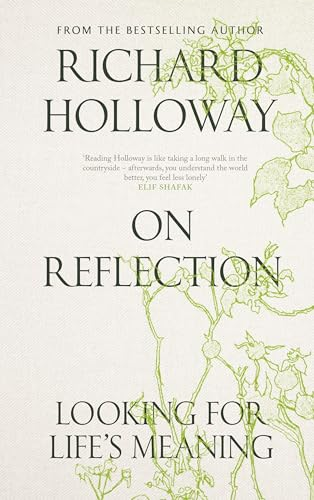 The best books are somehow like conversations, and this is one of them. Author Richard Holloway doesn’t get too far ahead of us, but leads us gently through his reflections, “looking for life’s meaning.”
This collection of essays by Holloway, former Primus of the Scottish Episcopal Church, begins with a reflection on “the absence of God,” a theme which has haunted him since his withdrawal from officiating in the Church. He has written a dozen or so companionable books since that momentous event, including one of the best autobiographies: Leaving Alexandria (Canongate, 2012).
Although rich in melancholy, these latest essays are also comforting, in the sense of a realisation that this is as good as it gets… or “This is IT,” as one chapter proclaims. There is fundamental philosophy concerning “where all the ladders start.” There are theologies of forgiveness and of grief. And there are deep appreciations of cultural icons like Yeats and Auden, Copland and Messiaen. Another theme which will be no surprise to those who know Leaving Alexandria is the importance of cinema: a parable is drawn powerfully from Blade Runner (1982).
A reflection on the Scottish character introduces a word new to me: ‘antisyzygy’ – “the contradictions of character…in…almost every distinguished Scot.” Yet the message of Holloway, for all his Scots’ pride, is universal advice: guard against religions overstepping their bounds. We may tolerate faiths that themselves are intolerant, only so long as their prejudices are contained within their own people. The issues which dominate this reflection are the liberation of women and the acceptance of gay people in secular society (but not yet into some conservative religions).
In the chapter on Secular Faith, there is a stark warning of the danger of what the ‘Voice of God’ in the head can lead to. The Voice telling you what not to eat is one thing, but the command to commit genocide is another.
He concludes with a plea “for modesty and humility in the claims we make about how we see things.” And a sentimental note on the poetry of Christmas Eve. And finally, the importance of gratitude for the universe, even if there is no one to thank.