Book Review — Lloyd Geering: Prophet or Heretic?
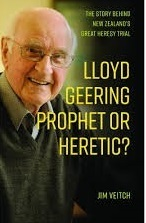 The author James (Jim) Veitch is a New Zealand academic and theologian with a long career in religious studies and church life. He is best known for his scholarship on Christianity, biblical interpretation, and the intersection of religion and modern culture, as well as for his work on the Lloyd Geering heresy affair that shaped New Zealand church history. His current position is Associate Professor in the Strategic Studies Programme of the School of Government, Victoria University of Wellington.
Overview
Lloyd Geering: Prophet or Heretic? revisits one of New Zealand’s most significant religious controversies — the 1967 heresy trial of Sir Lloyd Geering, a theologian whose progressive views challenged mainstream Christian doctrine. Jim Veitch places the trial and its aftermath in historical, cultural, and theological context.
The book explores not only the dramatic public trial but also the 1970 “dissociation” decision by the Presbyterian Church that sought to reaffirm the doctrines Geering had questioned — effectively undermining the earlier acquittal and revealing enduring tensions between institutional religion and evolving theological thought.
Re-examining the Heresy Trial
Veitch treats the 1967 trial as a watershed moment in Aotearoa New Zealand’s religious history, illustrating how Geering’s ideas on faith, scripture, and modernity collided with established doctrine. The analysis lays bare how issues of faith, freedom of thought, and ecclesiastical authority played out on a national stage.
Geering’s Courage and Conviction
Rather than portraying Geering as merely a controversial figure, Veitch describes him as a theologian of courage, integrity, and foresight, committed to reconciling Christian thought with the realities of modern culture. This places Geering as a prophetic voice ahead of his time — advocating openness rather than narrow doctrinal enforcement.
The book highlights the lesser-known 1970 decision by the Presbyterian Church to dissociate from Geering — conducted quietly and without giving him a platform to respond. According to Veitch, this was a significant miscarriage of justice and reveals deep institutional resistance to theological evolution.
Strengths of the Book
Clear Historical Narrative
Veitch uses archival materials, first-hand accounts, and scholarly insight to bring the era alive, giving readers a vivid sense of both the personalities involved and the societal backdrop of the controversy.
Balanced Yet Thought-Provoking
Rather than polemical praise, the book offers a balanced treatment — acknowledging both Geering’s impact and the complexities of church response. It invites readers to reflect on how religious institutions engage with change.
Contemporary Relevance
The book ties the 1960s/70s debates to the ongoing theological and institutional challenges facing churches today — including how tradition interacts with modern intellectual and cultural life. Generally, churches have followed the same path as The Presbyterian Church of New Zealand— promoting theology from 4th Century CE rather than from current times.
Key Issues in Book
Lloyd Geering, Professor and Principal of Knox College Dunedin, 1963 - 1971 – the institution for education of future Presbyterian ministers – to provide broad education but not indoctrinate to a particular perspective.
Lloyd’s thinking partially came from two sources:
Ludwig Feuerbach (1804–1872)
Lloyd explicitly identifies Feuerbach as a major influence. He views the idea of God as a symbolic word or a "construct of the human mind" that has no external referent.
Pierre Teilhard de Chardin (1881-1955)
Lloyd adopted Teilhard’s view of an evolving universe that moves toward greater complexity and consciousness. He views God not as an external creator but as the "ultimate mystery" found within the evolutionary process itself.
Geering Statements reviewed in heresy trial summarized:
Resurrection Issues:
-
Bible is not inerrant and not the “Word of God.”
-
Resurrection is not a historical event.
-
Empty tomb is a metaphor for belief that what Jesus lived for lives on.
-
Bones of Jesus lie buried somewhere in Palestine.
Life after Death
-
The idea of God as a spiritual being is obsolete, and the whole world of the supernatural unnecessary.
-
Man has no immortal soul.
-
Life After Death – was worldview at the Time of Nicaea 1700 years ago but no longer applicable (1967)
Principal Opponents in the 1967 Trial
Robert Wardlaw Layperson - Doctrinal Error
Rev Robert Blaikie Minister - Disturbing the Peace of the Church
The charges laid against Lloyd Geering in the 1967 trial.
Lloyds’s Thinking conflicts directly with the Westminster Confession,the foundation of Presbyterian theology. The historic Westminster Confession of Faith (1646) is one of the subordinate standards of the Presbyterian Church of Aotearoa New Zealand, along with the contemporary Kupu Whakapono (2010).}
After long discussion including presentations by Robert Wardlaw, Robert Blaikie, and Lloyd Geering:
Motion
Dismiss the charges against the Principal of the Theological Hall
Persuaded of his Chistian integrity and conviction.
Impressed by the urgency that gospel must be interpreted by people of today Convinced of Professor Geering’s fitness for office.
This motion passed and essentially the “Heresy Trial” ended.
Wardlaw then proposed a second educational college for ministers which would focus on theology of 400 AD this did not happen.
1967 Trial decision: Lloyd allowed to have opinions that he presented also allowed others to have those opinions or opinions that they themselves had generated.
1970 Dissociation Decision
Result of Interview that took place in Brisbane and was broadcast in Australia, when Lloyd clearly stated:
-
No afterlife no heaven no hell
-
Mother of Jesus not a virgin
-
Christ did not literally rise from dead.
-
Can speak of Jesus as son of God but not in literal sense.
-
Ascension is a myth.
-
Funeral Services should be rewritten.
At that time Lloyd ceased to be Principal of Knox College and became Professor of Religious Studies at Victoria University. He remained a Presbyterian Minister but kept the decision of transfer to Victoria University private until after disassociation decision was made.
In discussion it was noted that Lloyd could not be retried for the issues dealt with in 1967. Also Lloyd was not asked to speak to the issue. The motion to disassociate passed by the 1970 Assembly.
Veitch writes:
-
Church went into a theological recession.
-
Media went to Lloyd rather than church on religious issues.
-
Church looked “uncomfortably out of touch with society.’
-
Liberal wing of church faded and membership declined.
-
Young People ceased to turn up.
-
Essentially the church reverted to 4th century theology irrelevant in the 21st century.
Book Summary
Style and readability of Book
Clear but very detailed showing individuals involved and details of meetings and decision processes. Maybe too detailed for some readers.
Strengths and weaknesses
What works particularly well? Describes Dissociation decision of 1970, which is not emphasized in most current discussion. Essentially the church decided to endorse 4th century theology and ignore current academic thinking and such work as the Jesus Seminar which attempts to replace biblical explanations with the best form of reality and in which Lloyd became involved. This maybe explains why even to this day practicing members reject Lloyd’s work and thinking but perhaps this has meant the organization has become more irrelevant to general society whereas in 1967- 1970 it had the opportunity to be at the forefront of religious thinking and research.
Overall evaluation and recommendation
Well worth reading, particularly to understand the process of acceptance of Lloyd’s work and then the Church’s disassociation from it (an issue even today}.
John Warren
The book is obtainable for $69.99 from Hedley’s books (booksonline.co.nz).